Thank you for investing those 3 minutes to move ahead
Great job on completing the AI Readiness Quiz,
(Score based on a scale from 100)
Scroll down to see how you scored for each topic

Find your scores for each single topic below.
Whether you want to get started or accelerate your AI journey,
here are some tips, resources, and suggestions on how to improve in each of these areas
AI STRATEGY
Your score:
(Score on a scale from 0 -30)

A robust AI strategy aligns your business goals with AI capabilities to drive competitive advantage and innovation.
Without a robust strategy, you may end up investing in something that simply doesn't serve your specific needs.
What is highly recommended by others or hyped in the media could still be just the wrong decision for you.
If it comes to AI there is no one-size-fits-all solution.
If you don't have a strategy at all
You may have discussed AI informally, but without a structured roadmap, AI adoption remains a concept rather than an actionable initiative.
This often leads to hesitation, with businesses delaying AI adoption due to uncertainty about where to start.
Start by defining clear AI objectives that support your key business outcomes.
What do you need AI for exactly?
Which tasks and workflows should it take care of?
What impact will this have on the entire system?
If your score suggests room for improvement
Get together with your team, stakeholders, etc. to create a cohesive vision and identify entry points for quick wins—small, impactful projects that demonstrate the value of AI early on.
Regularly revising and aligning your strategy with evolving technologies, market trends, and the development of your own business can also greatly enhance your readiness.
NEED GUIDANCE?
Let's talk about how the deep dive AI READINESS DIAGNOSTIC can give you clarity on
your options,
your to-dos,
and your roadmap.
LEADERSHIP BUY-IN
Your Score:
(Score on a scale from 0-30)

Leadership buy-in is crucial for the successful adoption and scaling of AI technologies.
It starts at the top, ensuring that your leaders are informed and enthusiastic about AI's potential impacts on your business.
A misconception I am often confronted with is that leaders delegate everything concerning AI to their IT department, thinking of AI "just" being a tech topic. This couldn't be further away from the truth. The implementation of AI is an important leadership strategy, in which the tech part is secondary and the last part to be considered.
Tech is about tools and technical implementation. It's what needs to be done to turn a planned strategy into action. Therefore, it's crucial to have full understanding and backup up at the top.
If you don't have a strategy at all yet
Consider conducting tailored workshops that showcase AI success stories relevant to your industry.
Encourage your executives and stakeholders to engage directly with AI technologies through demos or strategic meetings with AI vendors and experts, which can demystify AI and spark interest in its potential.
Or go for a ninja approach (following all compliance rules applying!) and run a small pilot.
It might be something as simple as using an AI for notetaking, summaries, reports, to-dos, etc., or using GPT or any other LLM to generate drafts for content. Log the time savings and convince with tangible results.
If your score suggests room for improvement
Get together with your team, stakeholders, etc., to create a cohesive vision and identify entry points for quick wins—small, impactful projects that demonstrate the value of AI early on.
Regularly revising and aligning your strategy with evolving technologies, market trends, and the development of your own business can also greatly enhance your readiness.
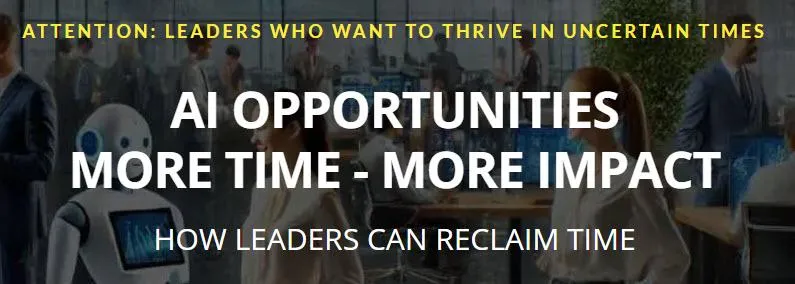
You're looking for some information on what's possible to achieve with AI
and how leaders can benefit?
Join
my free webinar on AI opportunities
AI Skills
Your Score:
(Score on a scale from 0-30)

Developing AI knowledge and ensuring adequate training are key steps toward leveraging AI effectively.
If your team has little or no AI skills
When teams lack AI knowledge, they may resist adoption due to fear of the unknown.
Without structured learning, AI adoption efforts often stall because people don't feel ready and hesitate to explore. At least some basic knowledge and skills should be there to create enough confidence to get curious and explore.
AI is nothing that's getting installed, and you're done. It excels if people keep adjusting and training it. Finding new use cases to use its full potential.
Consider conducting tailored workshops that showcase AI success stories relevant to your industry.
Encourage your executives and stakeholders to engage directly with AI technologies through demos or strategic meetings with AI vendors and experts, which can demystify AI and spark interest in its potential.
Or go for a ninja approach (following all compliance rules applying!) and run a small pilot.
It might be something as simple as using an AI for notetaking, summaries, reports, to-dos, etc., or using GPT or any other LLM to generate drafts for content. Log the time savings and convince with tangible results.
If your score points to room for enhancement
If only a handful of employees understand AI, organizational adoption remains fragmented.
The consequence: Without company-wide awareness, AI initiatives struggle to gain traction.
Initiate comprehensive AI literacy programs for employees at all levels.
Start with basic AI and data literacy courses and gradually introduce more specialized training aligned with specific roles.
Implement a structured AI learning program where employees across departments can experiment with AI tools and share best practices.
This will bridge knowledge gaps, make it easier to scale, and ensure AI knowledge is not limited to a few individuals.
Here's more:
You may have experts for certain tools in your team already, or people who love to dive into this. Put them in charge of spreading the skills.
Develop your own training program, tailored to your favorite tools and use cases.
You might want to appoint someone with the task of scanning the media for valuable information and learning nuggets.
Run internal challenges to make learning fun and get things done at the same time.
Future-proof your business and keep your staff motivated and engaged
AI is a tool to support humans, not to replace them.
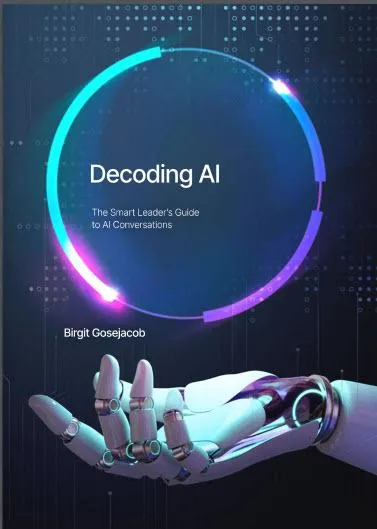
Download my Ebook "Decoding AI"
Decoding AI isn’t a technical manual—it’s a practical, no-nonsense guide designed for business leaders
CURRENT AI USAGE
Your Score:
(Score on a scale from 0-30)

If no AI tools are currently in use
You are limiting yourself in efficiency and innovation.
Your company may still be relying entirely on manual processes, leading to higher costs, slower workflows, and reduced competitiveness.
Many organizations fear AI implementation due to cost concerns, lack of expertise, or perceived complexity. Evaluating your current AI usage helps identify how AI is being applied and where it can be expanded.
To improve
Conduct an audit of existing AI tools and systems to assess their effectiveness and integration into daily operations.
Look for opportunities to expand AI use in high-impact areas and consider pilot projects to test new AI applications before full-scale implementation.
This approach helps mitigate risks and demonstrates potential ROI to stakeholders as well as getting you and your team in an explorer's state, learning to enjoy experimenting, learning, and improving.
Or, if you're advanced users, keep on going.
Markets and technologies are developing fast. Stay tuned, keep on track, and keep improving.
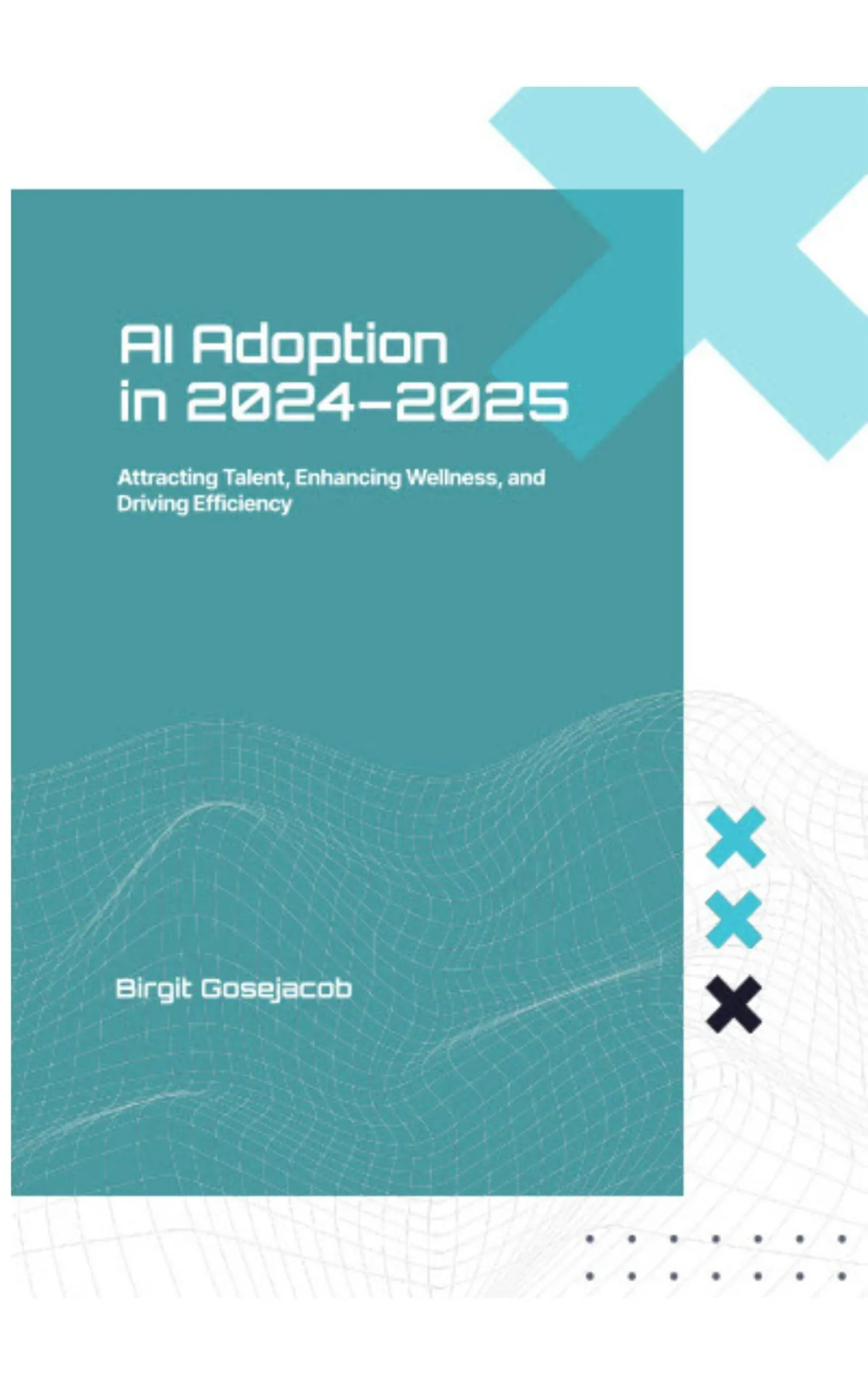
Need some ideas on what kind of tools are out there to boost your efficiency?
Get inspired on real life examples.
Download My Ebook (pdf)
AI Adoption in 2024-2025
Allocating Talent, Enhancing Wellness and Driving Efficiency
DATA READINESS
Your Score:
(Score based on a scale 0-30)

Data readiness is foundational to AI success and is very often overseen or not given enough attention.
It involves having accessible, high-quality data that AI systems can use to learn and make decisions.
Imagine AI as a child, an apprentice, or a new employee knowing literally nothing but having access to limitless information. Give this person a task without any training, any guidelines provided, any rules, or any context to understand the outcome will be anything but what you expected.
You'll very much be in to face a disaster.
Data readiness is homework to be taken seriously.
To improve your data readiness
Make sure you have established a strong data governance framework that addresses data quality, privacy, and security.
Start with a basic data audit—identify where your business captures data, for which purposes, where and how it stores data, and whether it is organized enough for AI-powered insights.
Create data plans.
Depending of the size of your organization, you might want to consider investing in data integration tools can also help unify data silos, providing a holistic view of information assets that are critical for effective AI deployment.
LET'S Find
potential experts in your team
and get them trained.
AUTOMATION & EFFICIENCY
Your Score:
(Score based on a scale from 0-30)

Increasing automation and efficiency through AI can transform operations, reduce costs, and free up employees to focus on more strategic tasks.
If your business processes rely entirely on manual effort
The good news: You have a lot of potential to boost your efficiency beyond your imagination.
Try this as a first step: Identify one repetitive task that could be automated or handled by an AI, such as scheduling, email responses, notetaking or data entry.
If there’s potential for improvement
Review your processes to identify repetitive tasks suitable for automation and pinpoint bottlenecks.
Starting small in areas with high manual processing can yield quick gains and build momentum for broader AI initiatives.
You want a professional workflow analysis,
suggested tools and guidance on the steps to take?
GOVERNANCE & ETHICS
Your Score:
(Score based on a scale 0-30)

Managing AI risks and ethics is essential to ensure your AI systems are fair, transparent, and compliant with regulations.
If you don't have anything in place yet
Start by developing an AI ethics policy that aligns with industry standards and regulatory requirements.
If your score shows room for improvement
Regularly training your team on ethical AI use and conducting AI audits can help mitigate risks.
Engaging with AI ethics experts or consultants can also provide deeper insights and strategies to manage potential ethical dilemmas and regulatory challenges.
Suggested to read or watch

Click to read the blog article:
Before AI: Why Trust is Your First Step Towards Technological Transformation

Click to read the blog article:

Click to watch on YOUTUBE:
https://youtu.be/e3qwkOz0CFk?si=F5Gx7xgnJGmi1VEl
AI Panel, Los Angeles Tribune Leadership Week,
Applied Intelligence & Soul-Aligned Systems: AI As A Mirror for Modern Leadership
You want to move ahead with an expert
guiding you step by step?

I am here to make AI as easy and affordable as possible for you:
With a focus on AI supporting you. Not to replace humans, but as a tool doing the work and reclaim time for humans to focus on the important things like strategy, innovation, building and strengthening human relationships, etc.
Giving you knowledge to confidentially decide what you really need to experience an impact and how to get there:
Sometimes AI is the best choice; sometimes a simple automation. Sometimes an off-the-shelf tool, and a challenge for your staff on prompting, does it.
I'll ask you questions like:
Do you really want to have one chatbot to engage with or specialized chatbots for different tasks performing way better?
Do you want as much human control as possible, or are you looking for AI agents to perform entire workflows autonomously?
And most important: Are you ready?
I bring deep AI expertise to provide strategic guidance on advanced AI applications. Together with my extensive expertise in human-centered leadership during transformations, I am bridging the gap between humans and tech.
My systemic approach empowers leaders to confidently navigate complex transformations by aligning technology with essential human needs and organizational goals, ensuring that AI solutions truly enhance and support human capabilities.

© Copyright 2026. Birgit Gosejacob.
All Rights Reserved.